The ceiling below the money
No. 03 · October 8, 2026 · Steve Raymond
On September 28 the Senate passed the Protect College Sports Act, 77–22. If it becomes law in anything like its current form, a school could pay athletes out of three buckets: the $21.6 million revenue-sharing cap from the House settlement, a new $22.5 million retention fund for its current players, and $5 million for women's and Olympic sports. Call it $50 million per school.
It is not law. The House is in recess until after the midterms, leadership has said the bill needs work, and the objections are coming from both parties. Whatever eventually passes will probably look different. But programs are building next year's roster budget now, and they have to do it with this sitting on the table.
Almost all the coverage is about what that number does to the top of the sport. That's fair. It was negotiated there, by the leagues that can spend it.
I've argued before that below the Power Four, the cap has always been the checkbook. For FCS programs that's more true still. But two provisions reach all the way down: keeping a player becomes its own budget line, and most players get one free transfer. Those two changes move something that matters more to a constrained program than any ceiling. I'll call it the surplus gap.
A ceiling binds only who can reach it
The Athletic's estimates put the average Power Four roster between about $20 million in the Big 12 and $35 million in the SEC. My modeled Group of Five averages run from $1–2 million in the MAC and Conference USA up to $5–9 million in the rebuilt Pac-12. FCS programs sit below all of it, and most never opted into revenue sharing at all.
For every program below the Power Four, the binding constraint is revenue, not law. Raise the ceiling to $50 million and nothing in their budget changes.
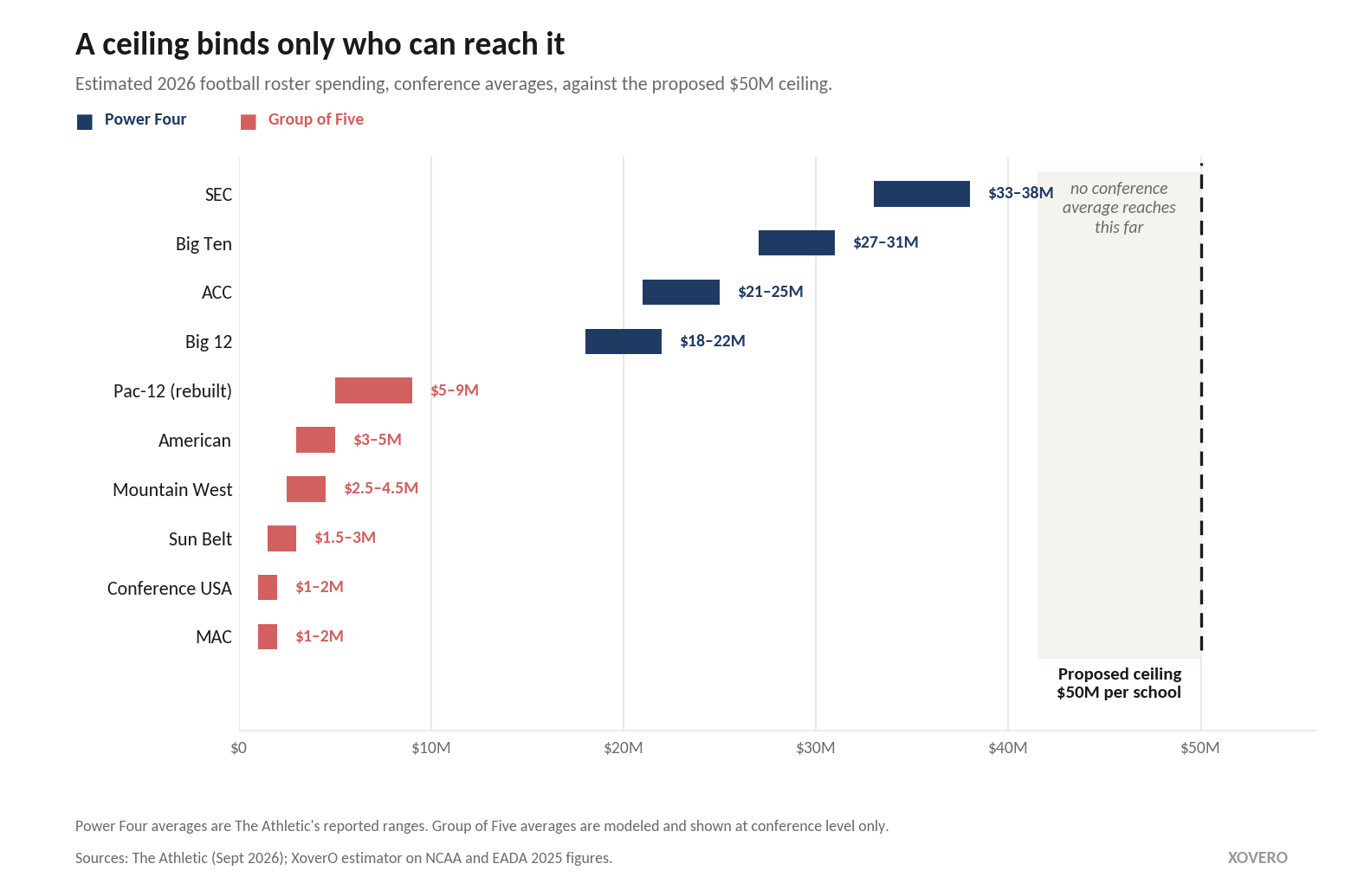
What changes is the market around them. A ceiling rises only for the schools that can fund it, so the dollar gap between tiers can widen even as the rules get tighter. The SEC already spends roughly nine times what the American does on its roster. A retention fund that only wealthy programs can fill makes that multiple bigger, not smaller.
The surplus gap
Every developed player carries surplus: the difference between what he's worth and what you pay him. Below the money that surplus is large, because development is cheap. A lineman who arrives at 260 pounds and leaves at 305 was paid in partial scholarship, coaching and time.
The surplus gap is the spread between what that player is worth to a buyer above you and what you can pay to keep him. Take a hypothetical: his program can offer him twenty thousand a year in aid, and a buyer one tier up will pay him well into six figures. Everything between those two numbers is the gap, and the portal is the market that closes it.
Programs below the money rarely lose developed players to bad relationships or bad coaching. They lose them because somebody above can pay the gap and they can't. As long as that gap stays open, part of every develop bet is a subsidy to the buyer.
What the ceiling does to the gap
Three things, and they don't all point the same way.
Less pull from above. The retention fund can only be spent on a school's current players. A program that can fill it keeps more of its own roster and needs fewer replacements. Portal demand is mostly replacement demand, so fewer holes at the top should mean fewer holes pulled open one tier down, and fewer again below that. The raids get less frequent.
A bigger prize when they come. Under a one-transfer rule, a player developed at home hasn't used his free move. A player who has already transferred has. That makes the homegrown player below the money the most valuable kind of acquisition: the buyer gets him once and then holds him, because his next move costs him a year. Buyers pay more for control, so the gap widens at exactly the moment it matters.
No matching money at home. The retention fund raises what a wealthy school can pay to keep a player. It does nothing for a program that can't fill it. The distance between the best offer from above and the best offer from home gets longer.
Put those together: fewer raids, each one more expensive and more permanent. Frequency down, severity up. For a program below the money, that turns an annual churn problem into a concentration problem. The question stops being how to survive losing half the roster. It becomes which four or five players you cannot afford to lose, and what it takes to keep them.
I'd hold all of that loosely. The bill isn't law and the House will amend it. A head coaching change still frees an entire roster. Graduate players stay free to move without limit. And my own turnover data shows what the last one-transfer era actually looked like: Group of Five turnover ran in the mid-forties from 2021 through 2023, not back down at the pre-portal 36 percent. A rule like this trims the increment. It doesn't restore the old world.
Why academics is the right lever
The retention fund comes with a string. Schools that miss graduation and academic progress benchmarks lose access to it. Most coverage treats that as a compliance hurdle. For a constrained program it's the most useful idea in the bill.
Worth knowing: the bill doesn't define the benchmarks. It delegates that to the NCAA and the conferences. So the thresholds that decide who can spend this money haven't been written yet, and they'll be written by the same bodies whose members are competing for the players.
Academics is the one retention tool a program below the money can match anyone on. It can't match a buyer's check. It can match a degree path, a staff that knows the player, and a clear line to graduation. Those have always been the real retention offer below the money. The bill just puts a federal price on the idea.
There's a catch, and it's the most interesting part of the model. Graduate players stay free to transfer without limit. So the academic success that keeps a program eligible for its retention money also turns its best developed players into free agents. The degree is both the program's qualification and the player's exit. Any retention model that treats academics as purely good for retention is wrong.
Retention as its own budget line
Whether a program can fill the federal fund or not, the useful move is the same: stop treating retention as something that happens inside recruiting, and run it as its own line with its own number.
Two things follow that are worth saying out loud. Spend where a dollar changes a decision, not where the talent is highest — the best player may be unretainable at any price you can pay, and the fifth-best may stay for a modest offer. And price the degree date, because an offer that ends at graduation buys nothing from a player who becomes a free agent the day he walks.
The rest of it — what a replacement actually costs you, how far an offer moves a given player, which positions justify the spend — is a modeling problem, and it's the one I'm working on against a real roster this season.
What this doesn't know yet
Plenty. The bill isn't law, the House is out until November, and the version that eventually moves will not be this one. The academic thresholds don't exist yet. It isn't clear how the bill treats FCS programs, most of which sit outside revenue sharing — my reading is that it turns on whether a school opted into the settlement, but that's my reading, not settled law.
The model has its own limits, and they're bigger than the bill's. Departure probabilities are estimates. Nobody has a clean dataset of retention offers and what happened next, because nobody has been collecting one. That's the gap I'm working on. I'm talking with personnel people up and down the tier ladder about what retention actually costs, and I'll test this against one real roster this season and publish what it says, including the parts that go against me.
The ceiling is about the top. The retention line is about everyone. For a program below the money, the question was never how much the big schools can spend. It's which players it can't afford to lose, and what it takes to keep them.
Next in this series, October 19: talent or scheme. All research →