The bet nobody prices
No. 01 · September 10, 2026 · Steve Raymond
Ole Miss recently hired a former Goldman Sachs veteran into a role covering cap management, revenue share, NIL and roster construction. It is a sensible hire and a clear signal of where the sport is heading. Programs are building the infrastructure to know precisely what they spend.
Knowing what you spend is not the same as knowing what it returned.
Here is what I think is happening, and I will not be able to prove it until December. Most programs below the money are making the develop-or-replace decision backwards. They are systematically overpaying for development and systematically underpricing what it costs them. And because nothing in the way a football program is organized closes the loop, the people making the decision have no way to find out.
That is a strong claim. Let me make it specific enough to be wrong.
The fork
A starter leaves. He graduated, or the portal took him, or he got hurt and never came back. You have to replace him, and you have two ways to do it.
You can buy a project. A high school kid or a young transfer with the frame and the athleticism but not the technique. He costs a fraction of what a finished player costs. In two years he might be the best player in your room.
Or you can buy someone ready now. A transfer who has played real snaps, who will start in September, who is probably close to his ceiling. He costs a multiple of the project. He will not surprise you in either direction.
Every coach in America has run this decision. Most have strong instincts about which way to lean, and those instincts are usually position-specific: certain rooms you develop, certain rooms you buy.
There is a clock running underneath it, and it has sped up.
Across Group of Five programs, the share of a roster that was not on it the year before held near 36% for most of the last decade. It is now 49%. Half a roster, replaced annually.
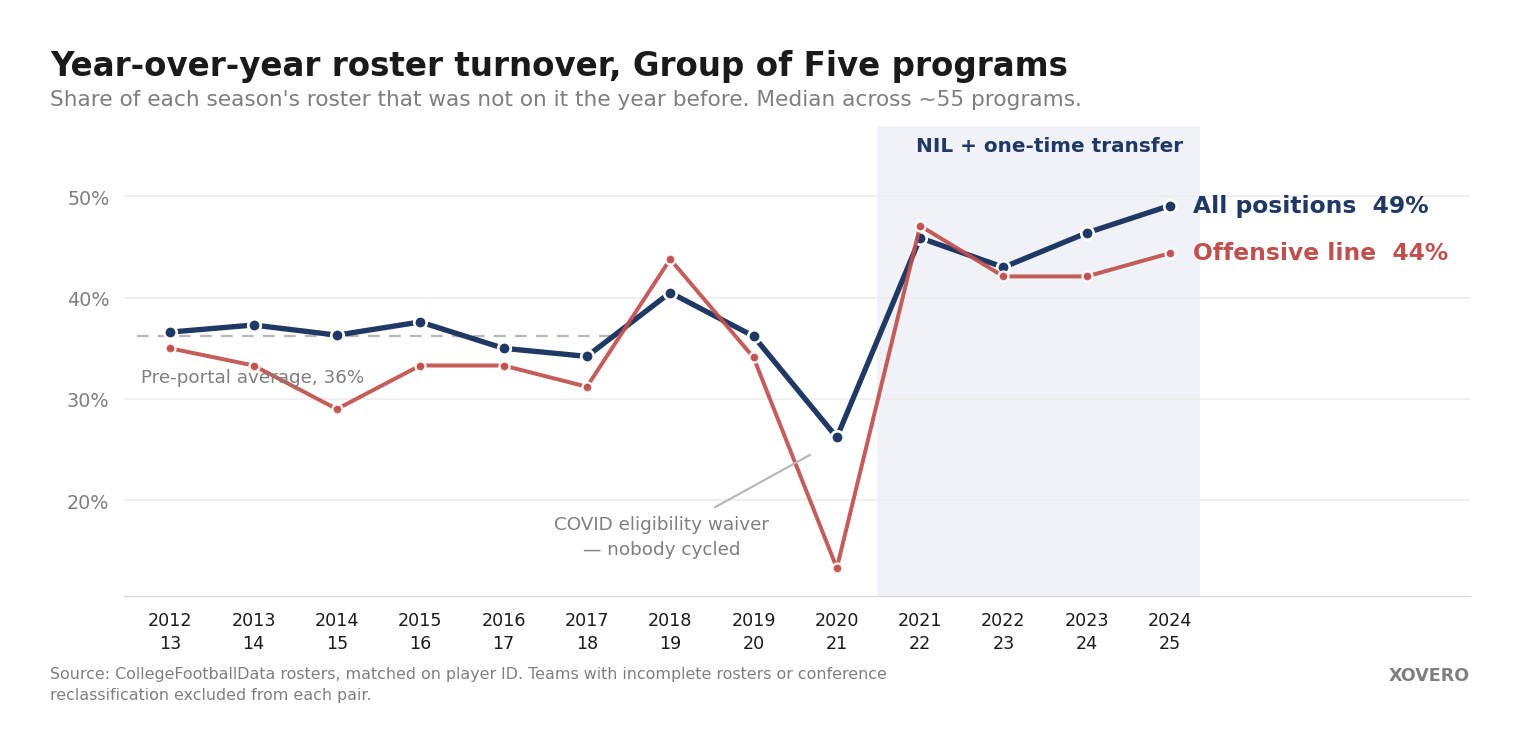
The timing is not what most people assume. The portal opened in October 2018, and turnover did jump the following season — and then fell straight back into the band it had occupied for six years. A one-year bump that did not hold. The durable break comes in 2021, when players could both move freely and be paid for it. It was never the mechanism. It was the money attached to the mechanism.
Development takes two or three years. The median program now replaces close to half its roster every twelve months.
Three claims I am willing to be wrong about
One. The develop path is overvalued, because two of its three costs are invisible.
A program comparing a $120,000 project against a $400,000 starter sees a $280,000 saving. That number is wrong, and it is wrong in a predictable direction.
It omits the season you pay while you wait. The project is cheaper in dollars and more expensive in outcomes, and the difference lands on your record, on your quarterback's health, and eventually on somebody's job. It is real money converted into a currency nobody tracks, which is the same as being free.
It also omits replacement cost. If the project works, you will not keep him. Which brings me to the part that I think is genuinely mispriced rather than merely unmeasured.
Two. Development success is a liability, and nobody books it as one.
Development, when it works, produces a player worth more than you are paying him. That is the same sentence as: he is now worth more to somebody else.
So the successful outcome of the cheap bet is a player you cannot afford to keep. You funded the development. Someone else fields the asset. The programs best at developing talent are, structurally, the programs that lose the most talent, and this is not a failure of culture or retention strategy. It is math.
Which means the develop path carries a liability the buy path does not, and I have never seen a program account for it. The ready-now transfer at his ceiling has no upside, but he also has no exit risk, because nobody is bidding for a player who has stopped improving. The project has both. Programs price the upside and ignore the exit.
Three. Programs treat the roster as one market. It is at least two.
Offensive line does not behave like the rest of the roster. Linemen turn over less — 44% against 49% in the most recent pair, and below the roster line in eleven of the last thirteen. The 2021 shock hit both groups at close to the same magnitude, so this is not a story about the line being insulated from the money. It is that the line runs at a persistently lower level, and persistence is what makes it a separate market rather than noise.
If that is right — and I think it is — then a program applying one development philosophy across an entire roster is misallocating before it evaluates a single player. The room where development has the best chance of being retained is not the room where most programs concentrate their development spending, because the decision is made by position group in isolation rather than by comparing rooms against each other.
I could be wrong about this one. It rests on a smaller sample than I would like, and there are other explanations. But it is checkable, and I intend to check it.
Why nobody has settled this
It is tempting to file all of this under recruiting. It is not a recruiting problem. It is a capital allocation problem.
A recruiting problem is about identifying and landing talent. This is about deciding what to buy with a fixed pool of money under uncertainty, where the cheap option has a delayed and probabilistic payoff and the expensive option has an immediate and capped one. That is a question about the cost of capital and the time value of an asset.
The reason it feels novel in football is that until recently, scholarships were counted rather than priced. You had a number of them and you distributed the number. A scholarship to a starting left tackle and a scholarship to a fourth safety were the same unit at allocation time. They were never the same thing, but nothing forced anyone to notice.
A budget forces you to notice. Once the resource is money rather than counts, everything becomes comparable in principle and nothing is comparable in practice, because the return side of the equation was never built.
So the decision gets settled the way most football decisions get settled. In a room, by people holding different information, resolved by whoever argues best or carries the most seniority. Two coaches can both be right and have no method for finding out which one is more right. That is not a criticism of anyone in the room. Given the tools available, there is no other way to settle it.
What happens next
The question is answerable. Not easily, and not with anything a program can buy off a shelf today. But most of what is needed already exists inside the building. It sits in different offices, held by different people, collected for different reasons, and it has never been put in the same table.
That is worth sitting with, because it means this is not a data problem. It is an organizational one. The reason nobody can price the develop-or-replace bet is not that the information is missing. It is that no one has ever been asked to bring it into the same room.
I am going to do that this season, in a place where the money is small enough that every decision shows up on Saturday. I will publish what I find in December, including if what I find is that the instincts were right all along and I was the one who was wrong.
That would be worth knowing too.
Next in this series, September 24: whether a bad grade means the player was beaten or the call was wrong. All research →